
Is the Catholic Eucharist a “False Christ”?
Introduction: The Accusation That Sparks Debate
One accusation appears again and again in debates about the Catholic faith.
You will see it in YouTube comments, hear it in sermons, and read it in online arguments.
The claim sounds dramatic:
“The Catholic Eucharist is a false Christ.”
According to this argument, Catholics are supposedly worshipping something that is not really Jesus. Critics claim that when Catholics believe the bread and wine become the Body and Blood of Christ, they are inventing another Jesus — or committing idolatry.
It’s a serious accusation.
Because if it were true, it would mean the Catholic Church abandoned the Gospel long ago.
But the moment you open the Bible and actually examine what Jesus said, the argument quickly collapses.
Because the belief in the Real Presence of Christ in the Eucharist did not come from medieval theologians or later Church traditions.
It came directly from Jesus Himself.
The Protestant Assumption: Communion Is Only Symbolic
Most criticisms of the Eucharist begin with one assumption:
Communion must be symbolic.
In this view, the bread and wine merely represent Christ but are not actually His Body and Blood.
Once that assumption is in place, critics look at Catholic teaching and conclude the Church must be adding something to Scripture.
But this assumption runs directly into one of the most shocking teachings Jesus ever gave.
The Bread of Life Discourse (John 6)
In John chapter 6, Jesus tells the crowd something that immediately causes confusion and controversy.
He declares:
“I am the living bread that came down from heaven; if anyone eats of this bread, he will live forever; and the bread which I shall give for the life of the world is my flesh.”
(John 6:51)
The reaction from the crowd is immediate.
Scripture tells us:
“The Jews then disputed among themselves, saying,
‘How can this man give us his flesh to eat?’”
(John 6:52)
At this point, if Jesus meant this symbolically, this would have been the perfect moment to clarify.
But He does the opposite.
He doubles down.
Jesus says:
“Unless you eat the flesh of the Son of Man and drink His blood, you have no life in you.”
(John 6:53)
Then He makes the statement even stronger:
“For my flesh is true food, and my blood is true drink.”
(John 6:55)
This teaching shocked the crowd.
Many disciples responded:
“This is a hard saying; who can listen to it?”
(John 6:60)
And then something remarkable happens.
The Moment Many Disciples Walk Away
John’s Gospel records something that should make every Christian pause.
After hearing this teaching:
“Many of his disciples drew back and no longer walked with him.”
(John 6:66)
Think about what just happened.
People left Jesus because of this teaching.
If Christ had meant it symbolically, He could have easily clarified the misunderstanding.
But He does not.
He allows them to leave.
Instead, He turns to the apostles and asks:
“Will you also go away?”
(John 6:67)
Peter responds with one of the most powerful statements of faith in the Gospel:
“Lord, to whom shall we go? You have the words of eternal life.”
(John 6:68)
The apostles stayed.
Not because the teaching was easy.
But because they trusted Jesus.
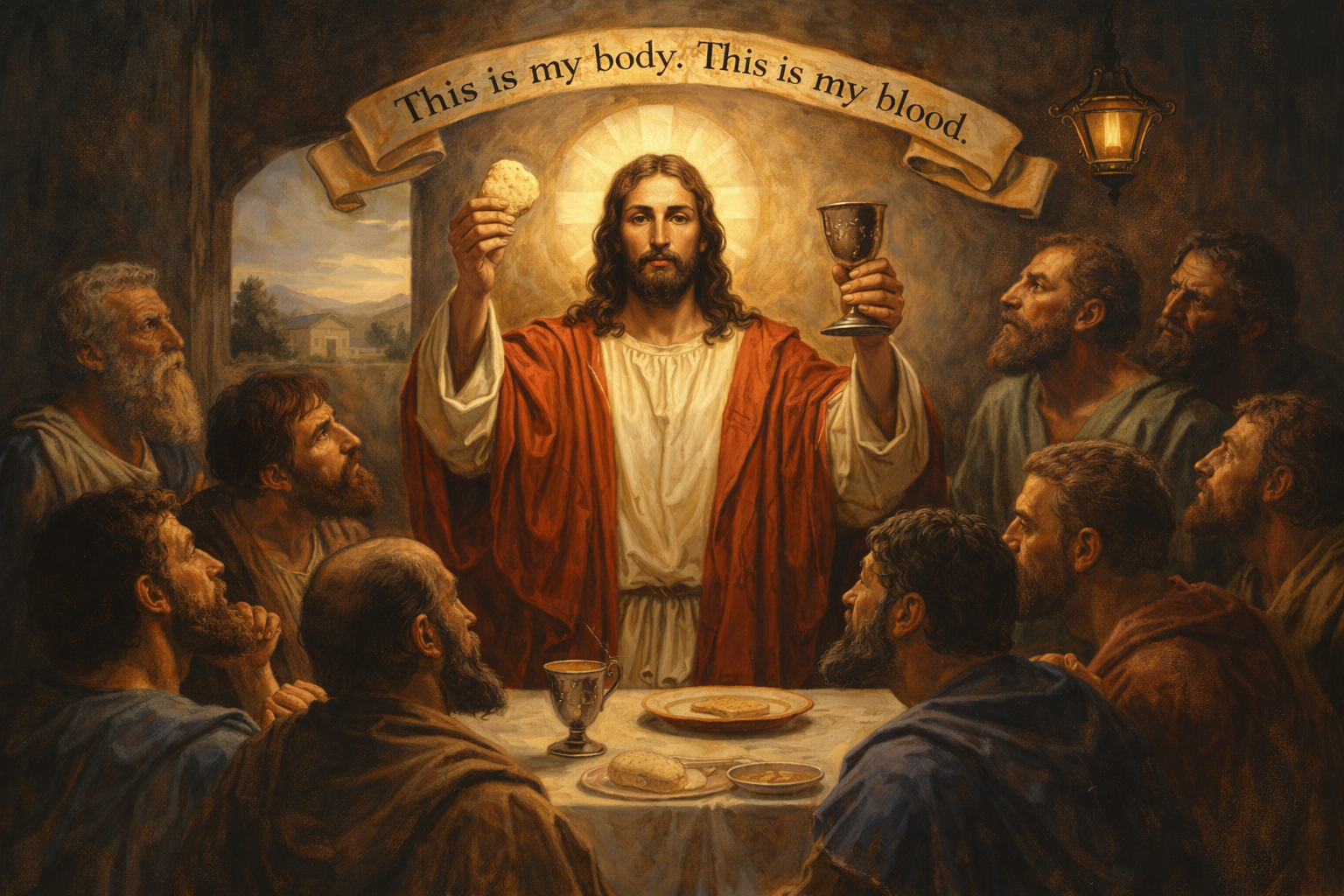
The Last Supper: Jesus Says It Again
The same teaching appears again during the Last Supper.
During the Passover meal, Jesus takes bread, blesses it, and says something extraordinary.
Scripture records His words clearly:
“Take, eat; this is my body.”
(Matthew 26:26)
Notice what Jesus does not say.
He does not say:
“this represents my body.”
He does not say:
“this symbolizes my body.”
He says plainly:
“This is my body.”
Then He takes the cup and declares:
“Drink of it, all of you; for this is my blood of the covenant, which is poured out for many for the forgiveness of sins.”
(Matthew 26:27–28)
Then He gives the apostles a command:
“Do this in remembrance of me.”
From that moment forward, the Church continued exactly what Christ commanded.
St. Paul Confirms the Real Presence
The Apostle Paul reinforces this belief in his letter to the Corinthians.
He writes:
“The cup of blessing which we bless, is it not a participation in the blood of Christ?
The bread which we break, is it not a participation in the body of Christ?”
(1 Corinthians 10:16)
Paul does not describe communion as a symbol.
He describes it as participation in Christ Himself.
He goes even further and warns Christians about receiving the Eucharist unworthily.
He writes:
“Whoever eats the bread or drinks the cup of the Lord in an unworthy manner will be guilty of profaning the body and blood of the Lord.”
(1 Corinthians 11:27)
That warning would make no sense if the Eucharist were only symbolic.
No one becomes guilty of profaning Christ’s body by mishandling a symbol.
The “False Christ” Argument Misuses Scripture
Some critics attempt to support the “false Christ” accusation by quoting Jesus’ warning in Matthew 24.
Jesus says:
“If anyone says to you, ‘Look, here is the Christ!’ or ‘There he is!’ do not believe it.”
(Matthew 24:23)
But this passage is clearly about false messiahs.
Jesus continues:
“For false christs and false prophets will arise and perform great signs and wonders.”
(Matthew 24:24)
Christ is warning about individuals claiming to be the Messiah.
In other words, people saying:
“I am Christ.”
This passage has nothing to do with the Eucharist.
Catholics are not pointing to a man and declaring him the Messiah.
We are believing what Jesus Himself said.
The Early Christians Believed the Same Thing
The belief in the Eucharist did not begin in the Middle Ages.
It appears immediately in early Christianity.
Around 107 AD, Saint Ignatius of Antioch wrote about Christians who rejected the Eucharist because they denied it was truly the flesh of Christ.
He warned that those who rejected this teaching were departing from the faith handed down by the apostles.
Later, around 150 AD, Justin Martyr described Christian worship and explained that the Eucharist was understood as the Body and Blood of Christ.
These writers lived only decades after the apostles.
And they believed exactly what Catholics believe today.
The Real Debate: Authority
At the end of the day, the disagreement about the Eucharist is not really about symbolism.
It is about authority.
Do we interpret Scripture based on modern assumptions?
Or do we trust the words of Christ as the apostles understood them?
Because from the earliest days of Christianity, believers understood the Eucharist as the real presence of Christ.
Not as a metaphor.
Not as a symbol.
But as the fulfillment of Christ’s promise:
“The bread that I will give for the life of the world is my flesh.”
The Bottom Line
The accusation that the Eucharist creates a “false Christ” misunderstands both Scripture and Christian history.
Catholics are not inventing another Jesus.
We are believing the words Jesus Himself spoke.
For nearly 2,000 years, Christians have believed that when Christ said:
“This is my body.”
He meant it.
Sources and References
Scripture References
• John 6:51
• John 6:52
• John 6:53
• John 6:55
• John 6:60
• John 6:66–68
• Matthew 26:26–28
• Luke 22:19–20
• 1 Corinthians 10:16
• 1 Corinthians 11:27–29
• Matthew 24:23–24
Early Church Sources
• St. Ignatius of Antioch, Letter to the Smyrnaeans (107 AD)
• St. Justin Martyr, First Apology (c. 150 AD)
• St. Irenaeus of Lyons, Against Heresies (c. 180 AD)
Key Catholic Teaching
• Catechism of the Catholic Church, §§1322–1419 (The Eucharist)
• Council of Trent, Session XIII (Real Presence of Christ in the Eucharist)
Historical Context
• Early Christian worship and Eucharistic belief recorded by Ignatius of Antioch and Justin Martyr confirm that belief in the Real Presence existed centuries before medieval theology.