
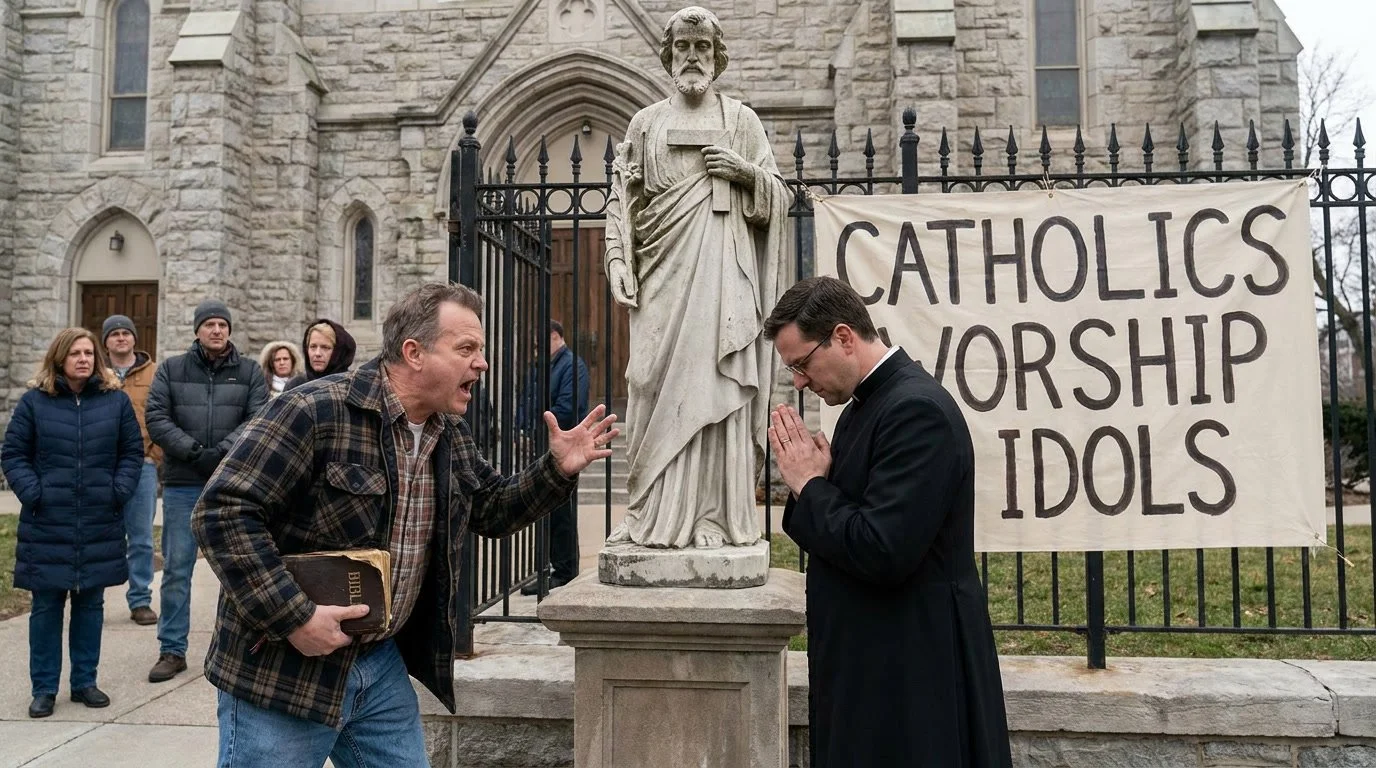
Do Catholics Worship Statues?
Introduction: The Accusation That Never Goes Away
"You worship statues."
For many Catholics, that accusation is not new. It appears in online debates, in comment sections, and sometimes even outside churches.
Some Protestants claim Catholics kneel before graven images. Others say Catholics pray to statues of Mary and the saints. Some argue that Catholic practice violates the Second Commandment.
From these claims comes a bold conclusion:
Catholics are guilty of idolatry.
But when you examine that claim closely, it runs into a serious problem immediately.
If Catholics worship statues, then God Himself commanded idolatry in the Old Testament.
And that is not just unlikely — it is biblically impossible.
So let's confront the accusation directly.
What Is Idolatry?
Biblically, idolatry is worshipping created things as if they were God.
It is giving to a creature the honor that belongs to the Creator alone.
The First Commandment makes this clear:
"You shall have no other gods before me."
The Second Commandment follows:
"You shall not make for yourself a graven image... you shall not bow down to them or serve them."
Critics point to this commandment and conclude that any statue in a church is forbidden.
But this interpretation ignores what happens immediately after God gives that commandment.
God Commands Statues for Worship Space
Right after God gives the Ten Commandments — including the prohibition against graven images — He turns around and tells Moses to make statues.
In Exodus 25:18-20, God says:
"You shall make two cherubim of gold... on the two ends of the mercy seat."
These were golden statues of angels.
And God commanded them for the Ark of the Covenant — the holiest object in Israel.
So the issue was never statues themselves.
The issue is what you do with them.
God forbids worshipping statues as gods.
He does not forbid using physical images to honor Him.
Catholics Do Not Worship Statues
Perhaps the most fundamental misunderstanding is this:
Catholics do not believe statues are God.
Catholics do not believe statues have power in themselves.
Catholics do not pray to statues.
What Catholics do is honor the saints those statues represent.
There is a difference between worship and honor.
Worship belongs to God alone.
Honor can be given to those who served God faithfully.
The Bible itself makes this distinction.
In 1 Chronicles 29:20, the people "bowed down" and "paid homage" to King David.
Were they worshipping David as God?
No.
They were showing respect and honor.
Catholics do the same when they kneel before a statue of a saint.
The Saints Are Alive in Heaven
Another key point critics often miss is this:
The saints represented by statues are not dead.
They are alive in heaven with God.
Hebrews 12:1 describes them as "a great cloud of witnesses" surrounding believers.
Romans 8:38-39 teaches that nothing — not even death — separates believers from the love of Christ.
So when Catholics ask a saint to pray for them, they are not praying to a dead person.
They are asking a living member of the Body of Christ to intercede.
Just as Christians ask each other for prayer on earth, Catholics ask the saints in heaven to pray.
The statue is simply a reminder of that real person who loved God and is now with Him.
The Incarnation Changes Everything
There is another reason Catholics use physical images in worship.
Jesus Christ Himself is the image of the invisible God.
Colossians 1:15 says:
"He is the image of the invisible God, the firstborn of all creation."
God did not stay invisible.
He took on flesh.
He became touchable, seeable, and physical.
The Incarnation means God Himself entered the material world.
And that changes how Christians relate to physical things.
If God can take on a body and let Himself be seen, touched, and even painted and carved into images for two thousand years — then the issue is not physical representations.
The issue is whether those representations lead us toward God or away from Him.
What the Early Church Believed
For critics who claim statues and images are unbiblical, history creates a problem.
The early Christian Church used images from the very beginning.
In the catacombs of Rome — where Christians hid during persecution — archaeologists have found paintings of Christ, Mary, and the saints.
These images date back to the second and third centuries.
For over 1,500 years, Christians honored saints through images and statues.
This was not a Catholic invention.
This was what Christians did before the Protestant Reformation even existed.
The Real Question: What Does Worship Mean?
At the heart of this debate is a misunderstanding of what worship actually is.
Worship is not kneeling.
Worship is not candles or reverence or devotion.
Those are postures that can be part of worship — but they are not worship itself.
Worship is giving something the place in your life that belongs only to God.
David danced before the Ark of the Covenant.
Solomon prayed in a Temple full of cherubim and images that God commanded.
Were they committing idolatry?
No.
They were honoring God through the sacred space He designed.
Catholics do the same.
The Bottom Line
When someone claims Catholics worship statues, the response is simple.
Catholics believe in Christ.
Catholics worship God alone.
Catholics honor the saints who followed Christ — and ask those saints to pray.
The statues are not the point.
They never were.
The saint represented — alive in heaven, part of the great cloud of witnesses — that is who Catholics are honoring.
Just like asking a friend to pray.
And biblically, historically, and theologically:
That is not idolatry.
That is the communion of saints the Bible teaches.
Sources and References
- Exodus 25:18-20
- 1 Chronicles 29:20
- Colossians 1:15
- Hebrews 12:1
- Romans 8:38-39
Early Church Sources:
- Catacomb artwork (2nd-3rd century AD)
- St. John of Damascus, On Holy Images (8th century AD)